APECS
Faster and safer electrification through smarter power electronics design
Published online: 08.04.2026

APECS
Faster and safer electrification through smarter power electronics design
Published online: 08.04.2026
Faster and safer electrification through smarter power electronics design
APECS
Published online: 08.04.2026
APECS
Published online: 08.04.2026
By Trine Reinholt Andersen, AAU Technology Transfer Office
As electrification accelerates across industries from renewable energy systems to EVs and industrial automation, the role of power electronics has become increasingly critical. Yet one persistent and often underestimated challenge continues to slow innovation: electromagnetic compatibility (EMC). Ensuring that power electronic systems operate without interfering with surrounding equipment or the power grid is not only a regulatory requirement but also essential for system reliability and safety.
Today, EMC compliance remains a complex, time-consuming, and costly process. Engineers often rely on late-stage testing and iterative redesigns, leading to delays, increased development costs, and uncertainty in time-to-market. As systems grow more complex and switching frequencies increase, these challenges are only becoming more pronounced.
APECS (Advanced Power Electronic Solutions), a spin-out from Aalborg University, was established to address these challenges.
At the core of APECS is the APECS-Lab build on the PEMC tool – a Power Electronics software tool for ElectroMagnetic interference pre-Compliance - originally developed through years of research at AAU Energy at Aalborg University. The tool enables engineers to evaluate electromagnetic interference (EMI) already in the design phase, even before the physical prototypes are built and, thus, shift EMC from a reactive, test-based process to a predictive and design-integrated approach.
Through a user-friendly interface, the software allows for faster and more accurate assessment of EMC performance compared to conventional methods. This reduces the need for costly redesign loops, enables faster iterations, and minimizes the risk of late-stage compliance failures.
By bringing EMC considerations upstream in the development process, APECS empowers companies to design systems that are compliant from the outset, saving both time and resources while improving the overall system robustness.
Diving deeper into APECS’ solution, the PEMC tool enables device-specific modelling, allowing engineers to simulate how individual components and switching behaviors contribute to overall EMI performance. Combined with a fast computation engine, this makes it possible to perform detailed analyses in a fraction of the time required by conventional methods, without compromising accuracy.
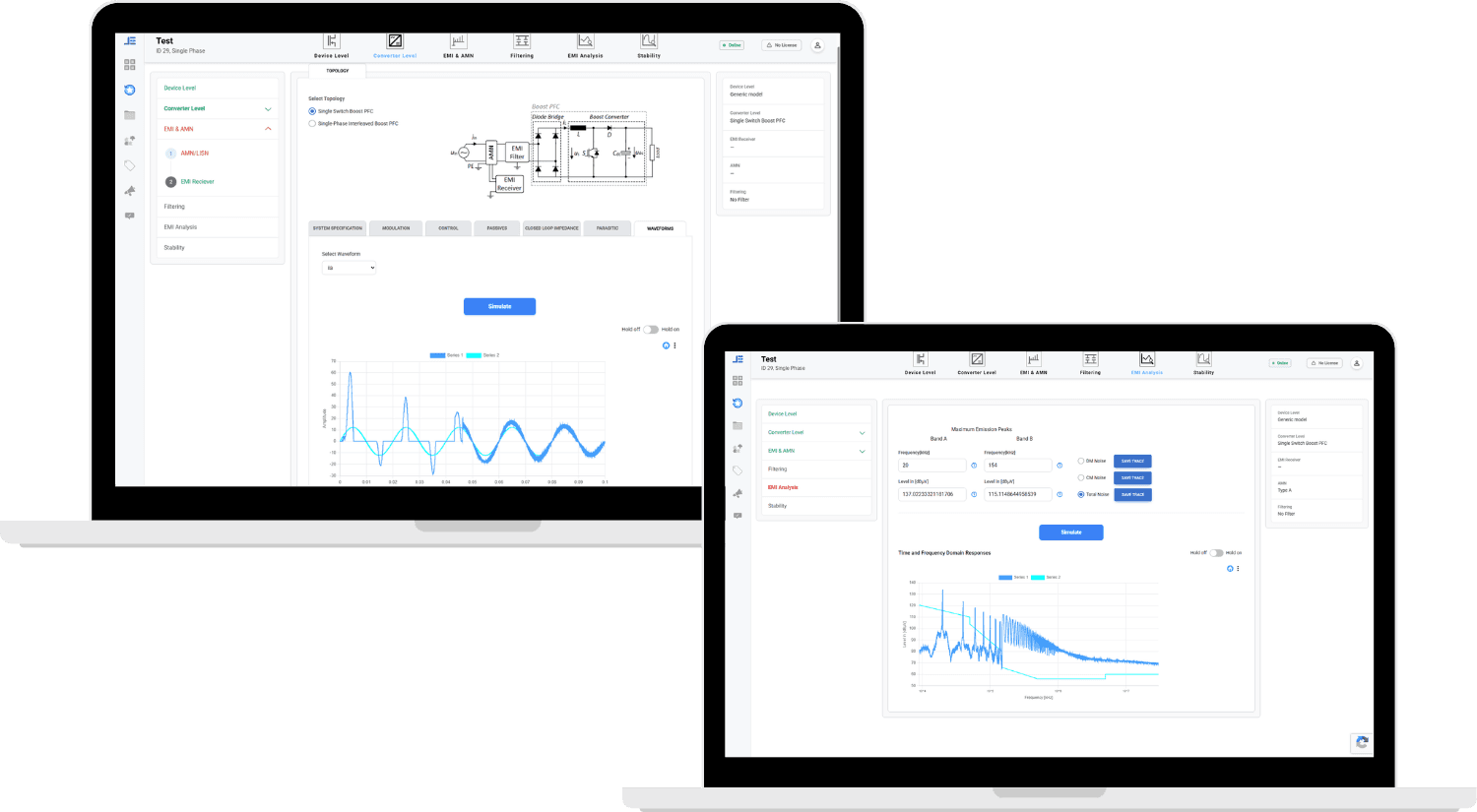
The platform supports a wide range of applications across modern power electronics, including multiple converter topologies and system configurations. Through an extensive component database and integrated EMI filter design support, engineers can evaluate and optimize designs holistically while balancing performance, efficiency, and compliance requirements within a single environment. This is particularly valuable as systems become more complex and operate at higher switching frequencies, where traditional rule-of-thumb approaches are no longer sufficient.
Despite its advanced capabilities, the solution is designed to be accessible and practical in real engineering workflows. A structured, step-by-step interface guides users through the modelling process, supported by ready-to-use libraries and preconfigured templates. Results can be exported and visualized through publication-quality graphics, making it easier to document, communicate, and validate design decisions across teams.
What began as a research project at Aalborg University has now taken the first steps toward commercialization in 2026. With support from Innovation Fund Denmark through an InnoExplorer in 2021 and later the Grand Solutions project “SUPRA-EMC” in 2023, APECS is now transitioning the research-based technology from laboratory development to industrial deployment.
Behind the idea and more than 10 years of research is Co-founder and CTO, Pooya Davari, who is also a Professor and Head of Section for Applied Power Electronic Systems at Aalborg University. Throughout the early commercialization process, the AAU Technology Transfer Office has been part of uncovering the potential of the technology, including IPR rights, preparing the business model, and the two applications for the Innoexplorer and Grand Solutions project.
In 2025, the spin-out was established in collaboration with Leap Solutions ApS. As the team behind APECS continues to refine and validate the software in collaboration with industry partners, the ambition is clear: to become part of the standard toolkit for power electronics engineers.